← Representative workflows

Complete product example

How CementOps answers: “How can I optimize the HRP?”

The nine screens below are the entire representative response produced by the Production & Process Control copilot. Nothing has been removed from the reasoning sequence, qualification, stop criteria, or request for plant-specific context.

Context before prescription

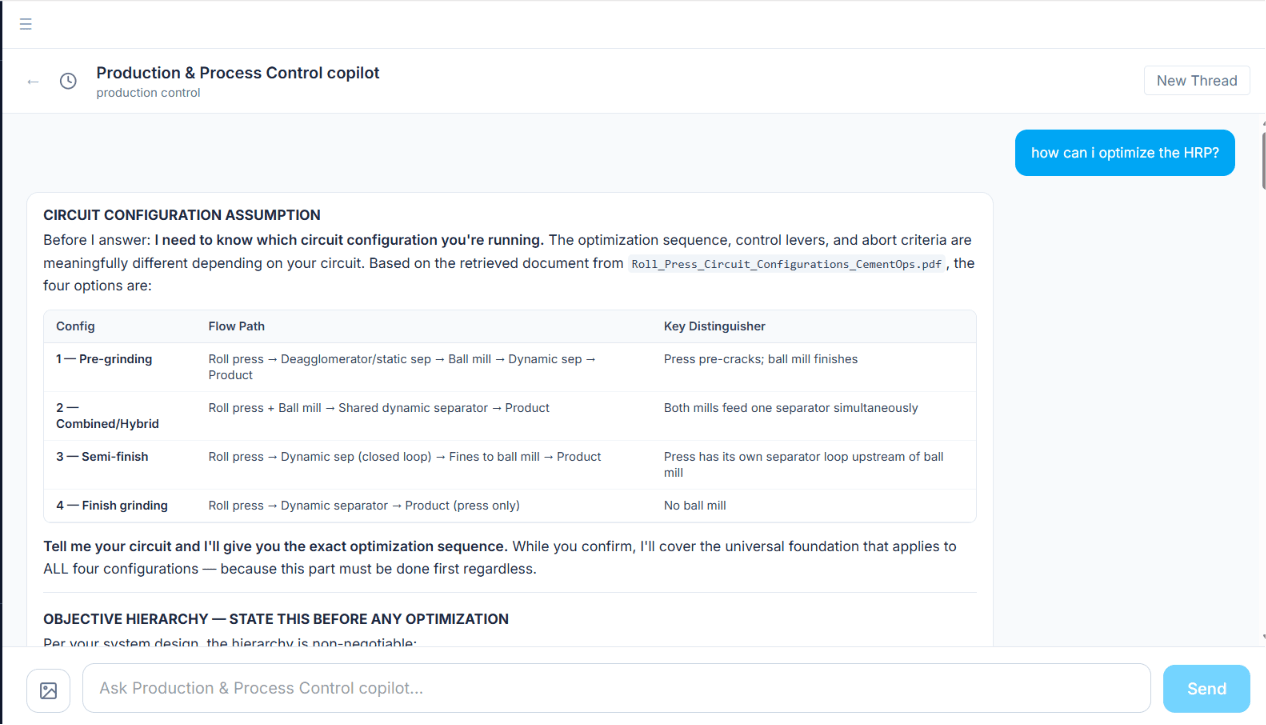
The copilot asks which circuit is running because the relevant sequence and constraints change by configuration.

System-level optimization

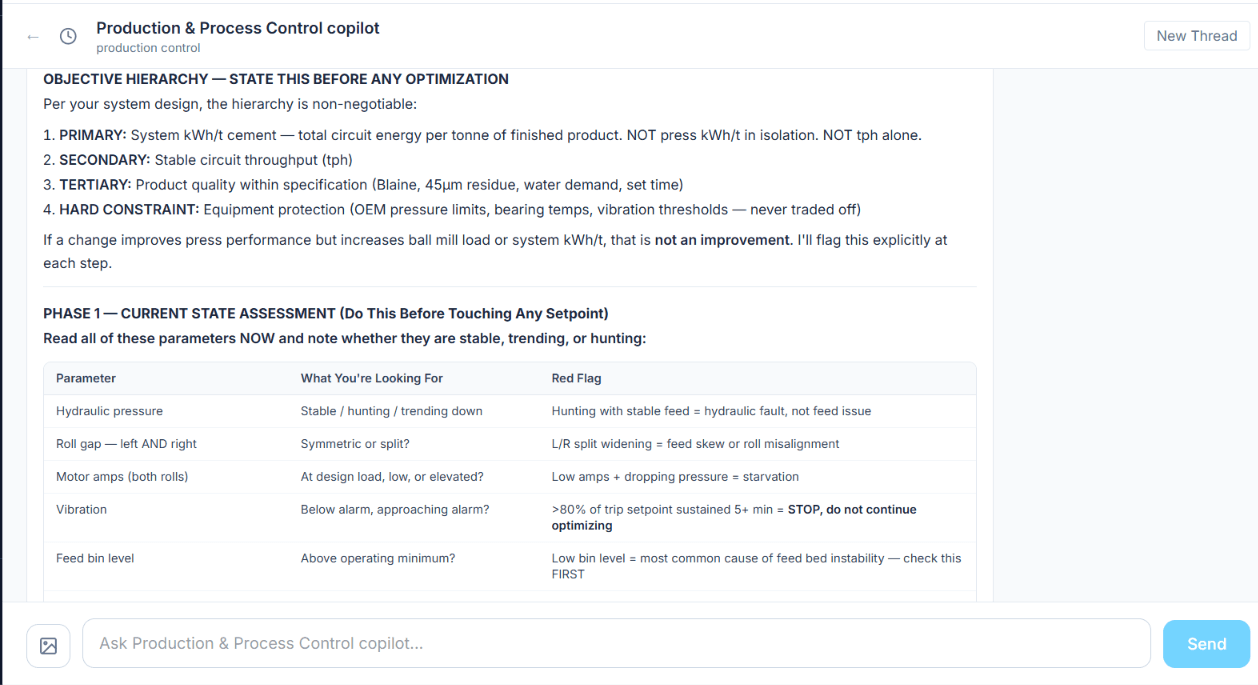
The objective is total circuit energy, stable throughput, product quality, and equipment protection—not press output alone.

Qualified authority retained

The response defers exact targets to approved plant and OEM limits and asks qualified personnel to verify the operating context.

Use boundary: This example demonstrates the copilot’s analysis method using no customer-confidential information. It is not a plant-specific operating instruction. Exact targets remain subject to the confirmed circuit, approved plant procedures, OEM limits, current conditions, and qualified plant review.

Full response sequence

Inspect the complete reasoning path.

Each screen appears below in the order delivered by the copilot.

  1. Response stage 01

    Circuit configuration gate

    1 of 9
    Production and Process Control copilot distinguishing four HRP circuit configurations before giving a configuration-specific answer
    The copilot distinguishes pre-grinding, combined or hybrid, semi-finish, and finish-grinding circuits before applying a configuration-specific sequence.
  2. Response stage 02

    System objective and current-state assessment

    2 of 9
    CementOps objective hierarchy and current-state HRP parameter assessment
    It establishes system energy, stable throughput, product quality, and equipment protection as the hierarchy before any setpoint change.
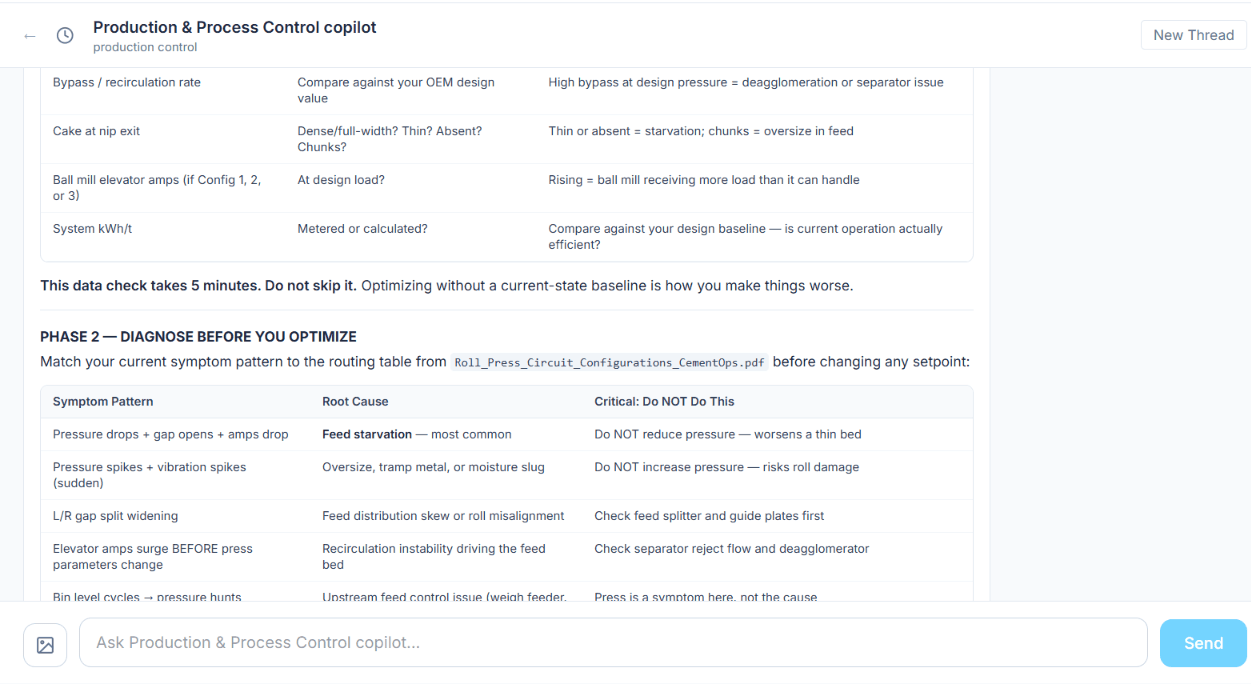
  3. Response stage 03

    Diagnose before optimizing

    3 of 9
    CementOps HRP diagnostic table routing symptom patterns to likely root causes and actions to avoid
    It routes symptom patterns to likely causes and identifies unsafe or counterproductive actions before proposing optimization steps.
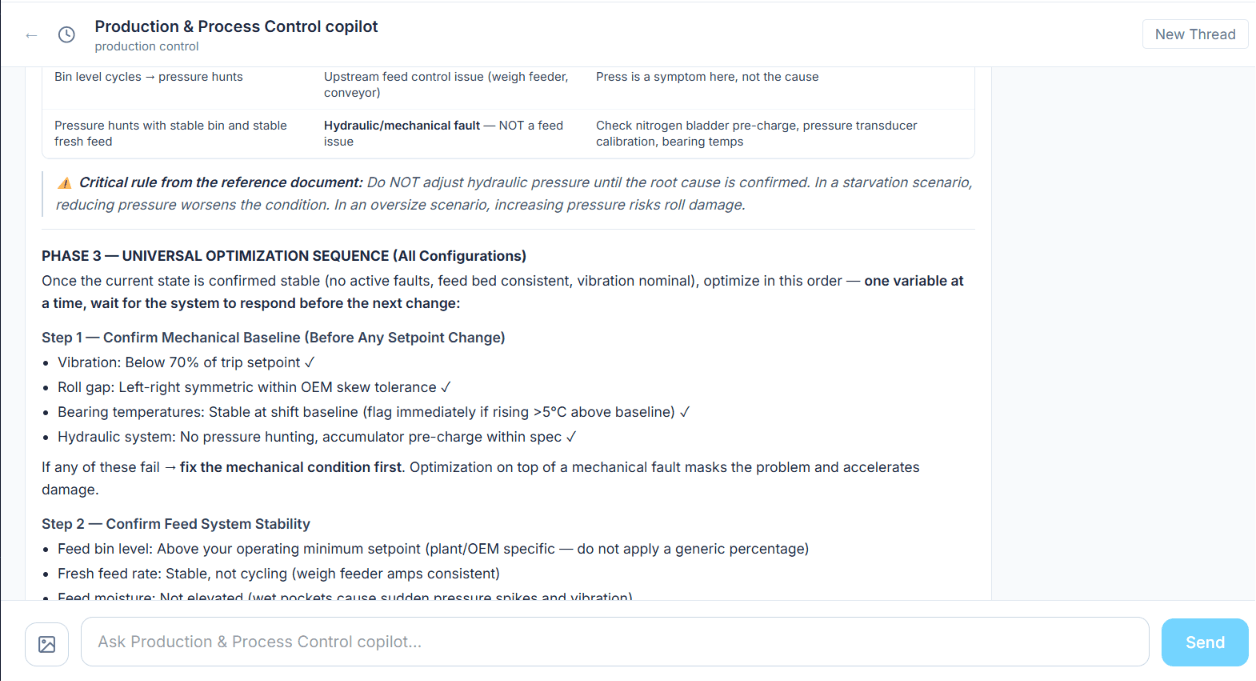
  4. Response stage 04

    Mechanical and feed-system baseline

    4 of 9
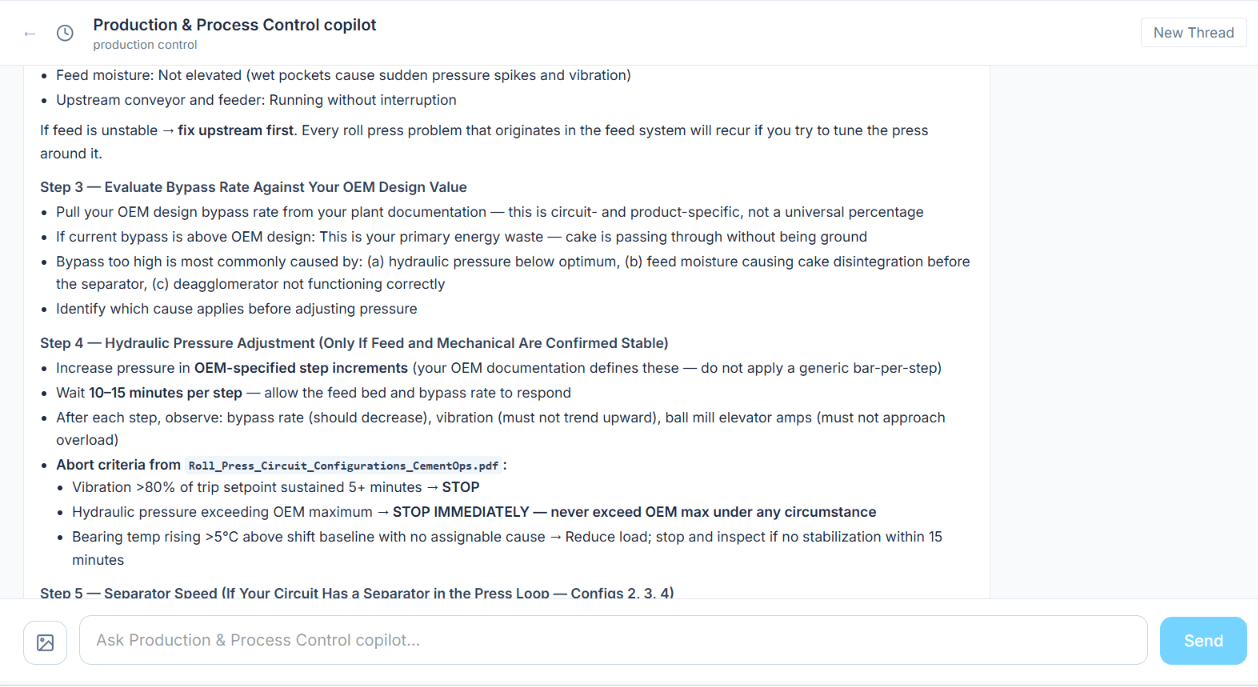
    CementOps HRP response requiring mechanical and feed stability before optimization
    The response requires stable mechanical and feed conditions before tuning the press, preventing process changes from masking equipment or upstream faults.
  5. Response stage 05

    Bounded hydraulic-pressure sequence

    5 of 9
    CementOps HRP hydraulic pressure guidance with hold periods, monitoring points, and abort criteria
    Pressure changes are constrained by plant and OEM limits, deliberate hold periods, observed response, and explicit stop criteria.
  6. Response stage 06

    Separator and system-energy verification

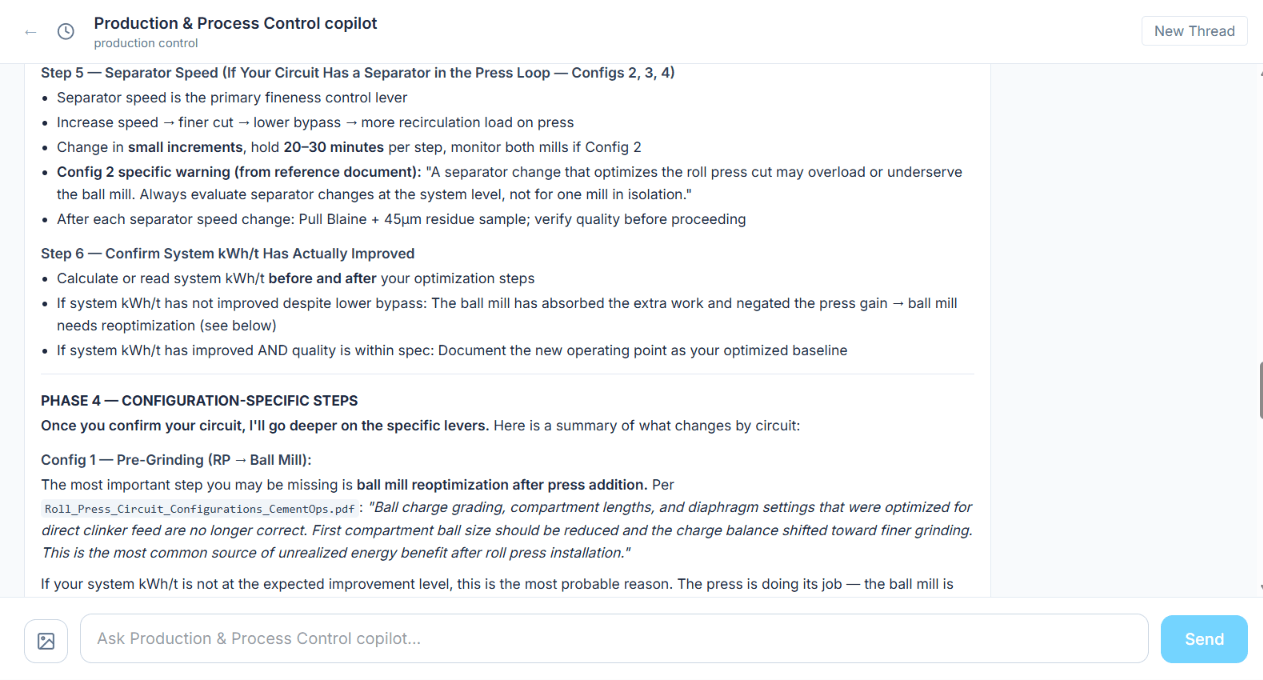
    6 of 9
    CementOps HRP response connecting separator changes, ball mill load, circuit configuration, and system energy
    It treats separator, ball mill, roll press, and total system energy as coupled variables rather than optimizing one machine in isolation.
  7. Response stage 07

    Configuration-specific logic and quality checks

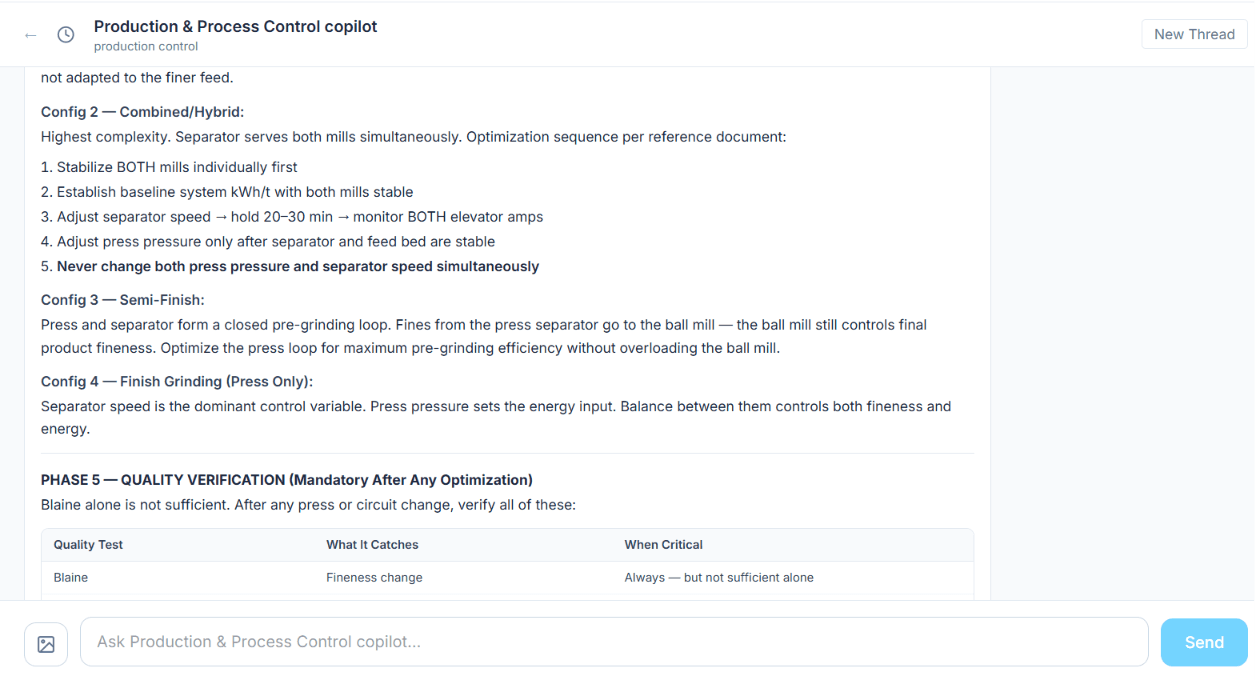
    7 of 9
    CementOps HRP configuration-specific optimization summary and mandatory product-quality verification
    The analysis varies by circuit configuration and requires product-quality verification after optimization.
  8. Response stage 08

    Quality risk and monitoring

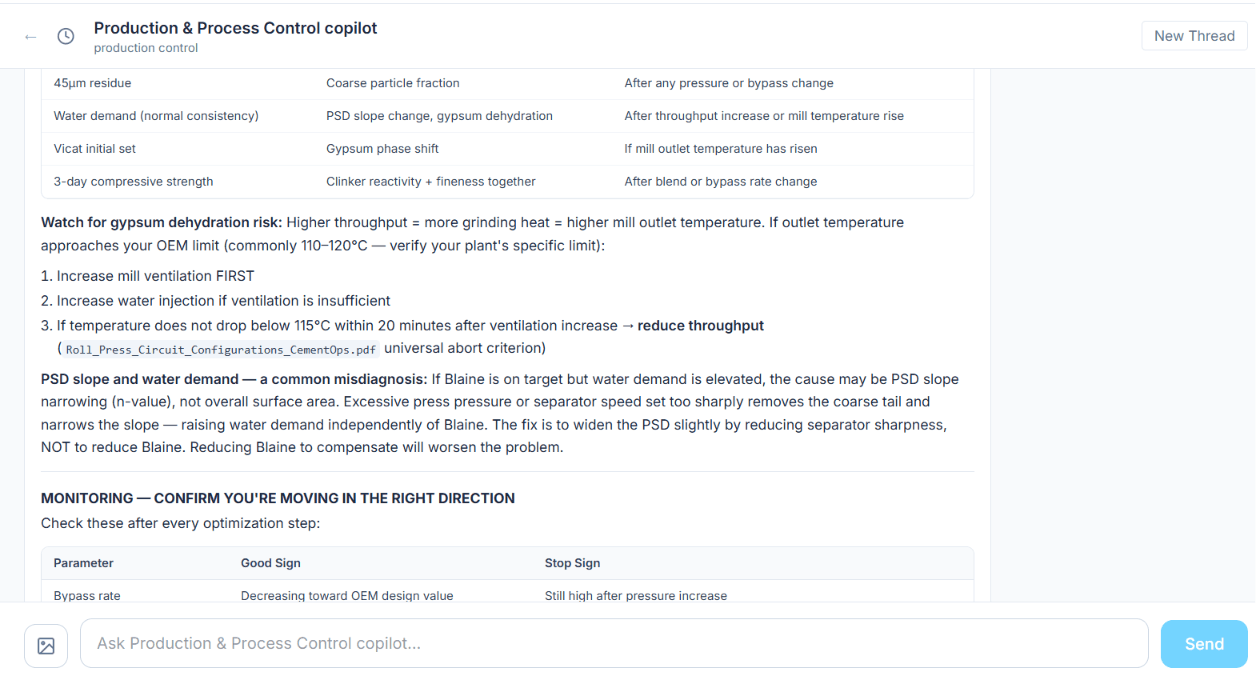
    8 of 9
    CementOps HRP quality verification covering residue, water demand, setting behavior, strength, temperature, and monitoring
    It connects fineness, residue, water demand, gypsum behavior, strength, and temperature to post-change validation.
  9. Response stage 09

    Monitoring and next data request

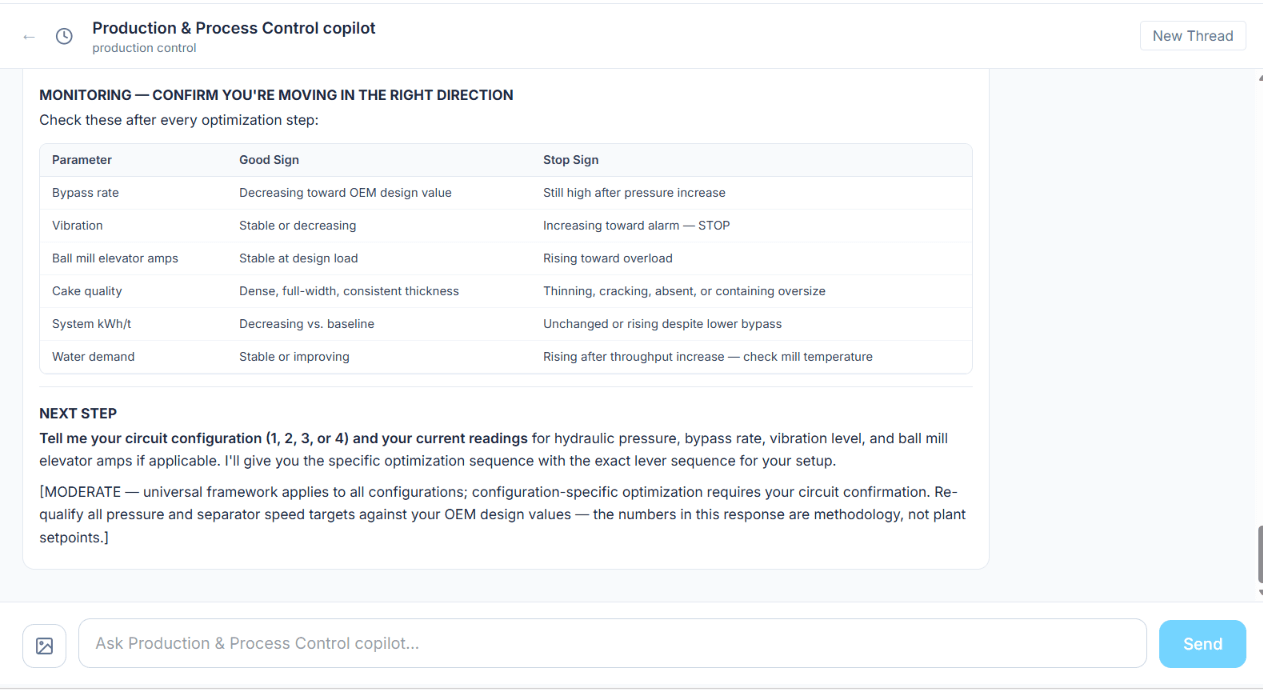
    9 of 9
    CementOps HRP monitoring table, next information request, and response-confidence qualification
    It closes with good and stop signals, asks for circuit-specific readings, and states the limits of the generalized framework.

Evaluate it against your workflows

Bring a representative plant question to a guided demonstration.

CementOps can demonstrate the same structured approach with public, synthetic, redacted, or otherwise approved information before any plant-specific data is authorized.